Why Writing is Part of My Healing


Imagination is powerful. There are whole worlds that exist in imagination. Kids seem to enter these worlds more easily. As adults, we are more often living in the worlds created in the imaginations of those who came before us.
As a little boy, I wrote plays and stories. Around age eight, I began to keep a diary. Many years later, a publishing house found my work with Black Boys OM and asked if I would create what became A Healing Journal for Black Men. In it, I shared my practices at the time and amplified the yogic practice of Atma Vicara (self-inquiry), expanding it into modern practices of self-reflection, self-discovery, and self-affirmation. I am grateful because over twenty thousand Black boys and men are utilizing that journal and each week more discover it.
I consider myself a futurist. For the past few years, I have extended my experience as a meditation and yoga teacher into written work because I believe Black wellness is central to Black futures. Afrofuturism grew from Black science fiction, jazz, visual art, and cultural criticism as a way to imagine Black futures while reclaiming African histories and challenging erasure. The term was coined by Mark Dery in 1993, but its roots are often traced to earlier work by artists and writers such as Sun Ra, Samuel R. Delany, and Octavia Butler, whose work linked technology, liberation, and Black identity.
Lately, I have been exploring healing through writing in another way: worldbuilding. At the end, I will share a writing practice that I hope encourages and inspires you.
Two years ago, I started an Afrofuturist novel, A Walk in the Night Sun, that I am now working to complete. You can read or listen to Books One and Two here.
I most recently finished a Black Americana novel, The Auspicious Life of the Whites.
When I was fourteen, I visited my family on the coast of Georgia and went to Sapelo Island. There I met a woman who told me about her ancestor, a prominent Muslim scholar, and shared that his wife and nearly twenty children were all sold together, which was extremely rare. Her story stayed with me, and I dedicated the book to her and her ancestor.
It is a work of fiction, but the themes that matter to me, such as reparations theory, Black liberation, and Black wellness, run throughout. I use imagination to plant seeds, like the idea of taking the case for reparations to the Supreme Court, or a main character with a generational legacy of creating secret cities for Black people around the world.
Two days ago, as I was doing my final read-through ahead of the book’s release next week, I saw that the DOJ is counter-suing reparations efforts in Evanston, Illinois. In my book, something similar happens. It never ceases to amaze me how art and real life mirror each other.
There are moments when writing becomes practice instead of production. In these moments, story functions as a way to focus attention, shift perception, and reconnect to what is often overlooked in daily life. Story can help clarify experience and open space for new ways of seeing and being.
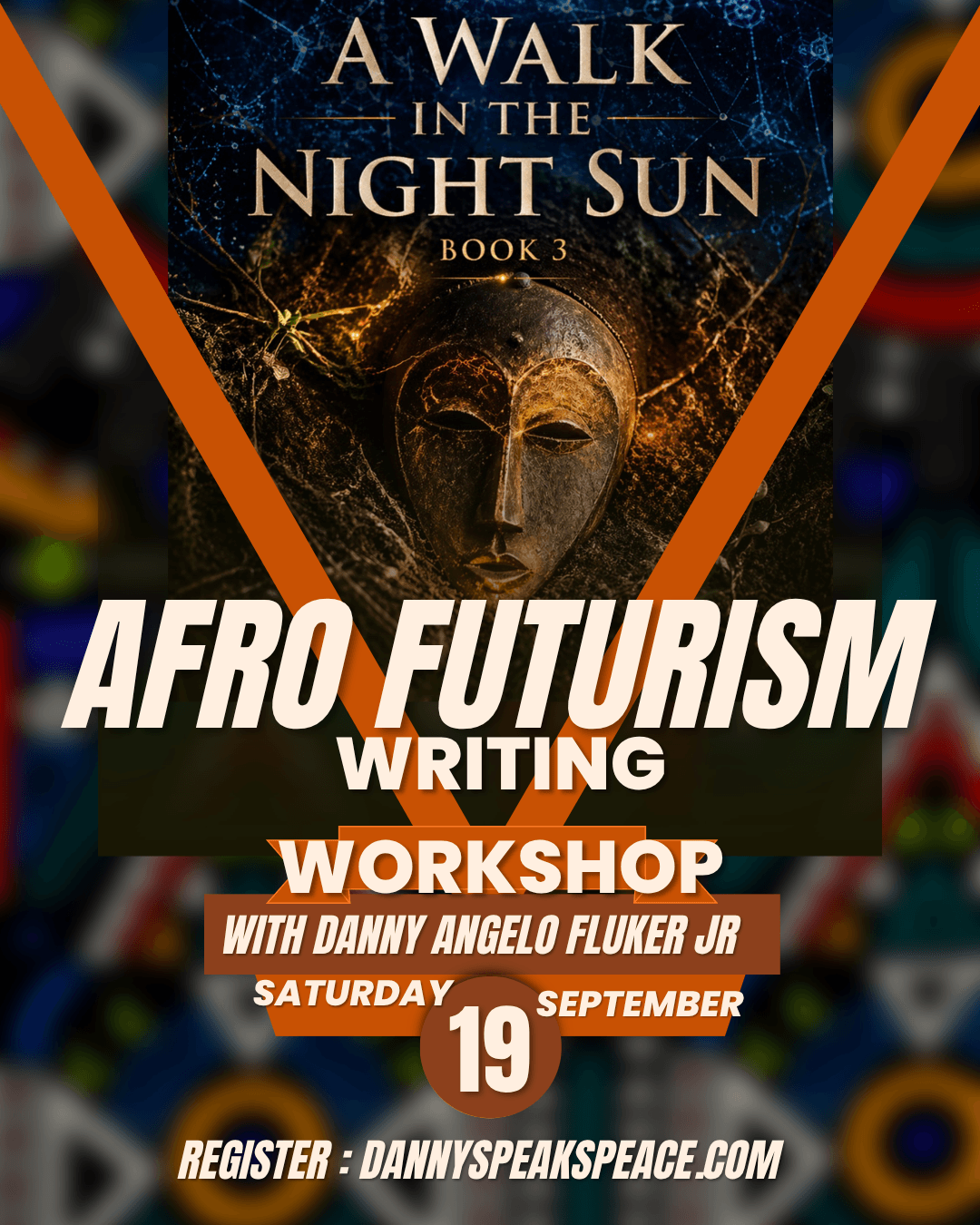
In my Afro Futurist workshop later this year, we will explore Afrofuturism, creative writing, and mindfulness. We will draw from the frameworks in A Walk in the Night Sun and my book Write What Heals: World Building as Healing Practice. The focus is on worldbuilding as a method of reflection and healing. We will look at how imagination can support a clearer orientation toward the future and more intentional ways of engaging with the present.
I have an Afro Futurist workshop that offers space to write from that approach. If you are interested in attending, the waitlist is now open for registration details and updates for Saturday, September 19th.
Next month, I am hosting a Book Publishing workshop where I share what I have learned in both traditional and self-publishing. If you want support in getting your book out into the world or finding a publishing house. I would be honored to have you.
Black Boys OM has paused its quarterly healing circles due to a loss of funding. There is a healing circle, You Good, held by WalkGood LA and BEAM this weekend, and I encourage you to check it out. Yoga Therapist Osiris Booque is also hosting a Summer Healing Series. Check Eventbrite to see if there are Black wellness circles in your area. It is important to support the Black wellness ecosystem that currently exists as it continues to grow and impact the culture. We are at a unique moment in time and Black Wellness Ecosystems has and will continue to meet these moments to support the wellbeing of us all.
As promised, here is a Writing for Healing practice that I hope supports you.
Thanks for reading
-Danny Angelo Fluker Jr
Writing for Healing Practice
Find a quiet moment and bring your attention to your breath. Notice the inhale as it arrives, the exhale as it leaves. It’s ok to let it be what it is, deep, shallow, both. Just observe.
As you settle, bring to mind the practices that help you stay grounded when the world feels heavy or disorienting. This might be meditation, prayer, walking, breathwork, journaling, silence, music, community, or rest. Let yourself remember what it feels like in the body when you return to one of these practices. Notice any shift, even subtle, in your shoulders, your jaw, your chest, or your stomach.
Stay with that felt sense for a few moments. If thoughts arise about current events, personal stress, or collective harm, honor it all as valid and also let them pass through without holding them. Return again and again to the breath and to the body that is still here, still living, still able to feel.
When you are ready, begin to write.
Write a short story rooted in the practices that keep you grounded. Let those practices become part of a character’s life. This character can live anywhere you imagine. A family, a neighborhood, a city, a forest, a future world, or a place that does not yet exist.
Place this character inside a moment of tension or harm that reflects something real in the world today. It does not need to be named directly, but it can be felt.
Then show how the character turns to their grounding practices in the midst of it. Let those practices steady them, clarify perception, and help them listen more deeply to what is needed. From that place of steadiness, allow action to arise if action is needed. This action does not have to be large or heroic. It might be a conversation, a boundary, a refusal, a protection, a repair, a collective gathering, or a small but clear act of care that interrupts harm or shifts direction.
Let the story hold both inner practice and outward response. Let stillness and action inform one another.
If writing is not accessible in this moment, speak the story out loud into an audio note or recording. Let your voice carry it. Trust your imagination to shape the world as it comes.
When you finish, read or listen back once without editing. Notice what you were able to witness, create, or release.